
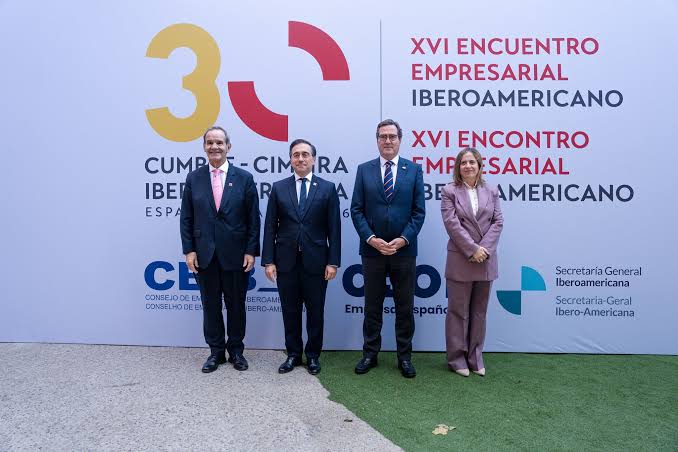
Public-private collaboration, productive transformation and technological development were the core themes of the 16th Ibero-American Business Summit, held in Madrid, Spain.
Economic cooperation among Ibero-American countries is taking on special relevance in an international landscape shaped by technological transformation, shifting supply chains and the need to strengthen business competitiveness.
Against this backdrop, Madrid, Spain, was the scheduled venue of the 16th Ibero-American Business Summit, convened for November 3 and 4, 2026, as a forum for dialogue between business leaders and public authorities from across the region.
The initiative was organized by the Ibero-American General Secretariat (SEGIB), the Council of Ibero-American Business Leaders (CEIB), the Spanish Confederation of Business Organizations (CEOE) and several other business organizations.
The summit was conceived as a platform to analyze the economic challenges shared by Ibero-American countries and to explore collaboration mechanisms capable of driving investment, innovation and productive development.
Public-private cooperation in the face of economic challenges
One of the main takeaways of the summit was the need to strengthen the relationship between governments and companies to respond to the transformations of the international economy.
Under the theme “Ibero-America Facing the Challenges of the Global Economy: Strengthening Public-Private Collaboration,” the event highlighted the importance of building conditions that favor economic growth and regional competitiveness.
This perspective is particularly relevant at a time when companies face new demands related to digitalization, productivity, technological adaptation and market integration.
Cooperation between public and private institutions offers a path to develop investment projects, improve business capabilities and create growth opportunities across different economic sectors.
Four pillars to drive business development
The agenda of the 16th Ibero-American Business Summit was structured around four areas considered strategic for the region’s economic future.
The first pillar addressed the global context and the structural transformations of the international economy, as well as their implications for Ibero-American countries.
The second focused on strategic assets and public-private cooperation, with particular attention to productive transformation processes and the strengthening of regional economic capabilities.
The third was devoted to innovation, the knowledge economy and entrepreneurial ecosystems, elements that are becoming increasingly important in the creation of new business models.
Finally, the fourth pillar covered inclusion, equality and the conditions needed to foster broader productive development.
These topics reflect some of the main challenges Ibero-American economies face as they seek to strengthen their position in international markets.
Mexico and opportunities for trade integration
For Mexico, Ibero-American business forums represent an opportunity to strengthen trade relations and explore new avenues of collaboration with other markets.
The Mexican Business Council for Foreign Trade, Investment and Technology (COMCE) promoted the participation of the Mexican business sector through an invitation addressed to business leaders interested in the summit.
In the invitation, signed by Sergio E. Contreras, president of COMCE, the council emphasized the importance of business participation in strengthening trade ties between Mexico and Ibero-America.
Trade diversification is a key issue for Mexican companies seeking to expand their international opportunities, identify strategic partners and strengthen their presence abroad.
In this regard, dialogue with business organizations from other markets can facilitate the exchange of experiences, insight into new trends and the identification of areas for cooperation.
Innovation and knowledge as drivers of competitiveness
Another central aspect of the summit was the role of innovation as an engine of economic transformation.
The knowledge economy, entrepreneurial ecosystems and the development of new business capabilities are among the tools that can help improve productivity and strengthen organizational competitiveness.
For Ibero-American companies, these factors also represent opportunities for collaboration in sectors linked to technology, specialized services and the development of new business models.
The approach of the 16th Ibero-American Business Summit underscores the importance of maintaining spaces for regional collaboration where governments, institutions and companies can exchange perspectives on the economic future.
In a constantly changing global environment, the ability to build alliances, drive innovation and strengthen trade relations will remain a key factor for business development across Ibero-America.
